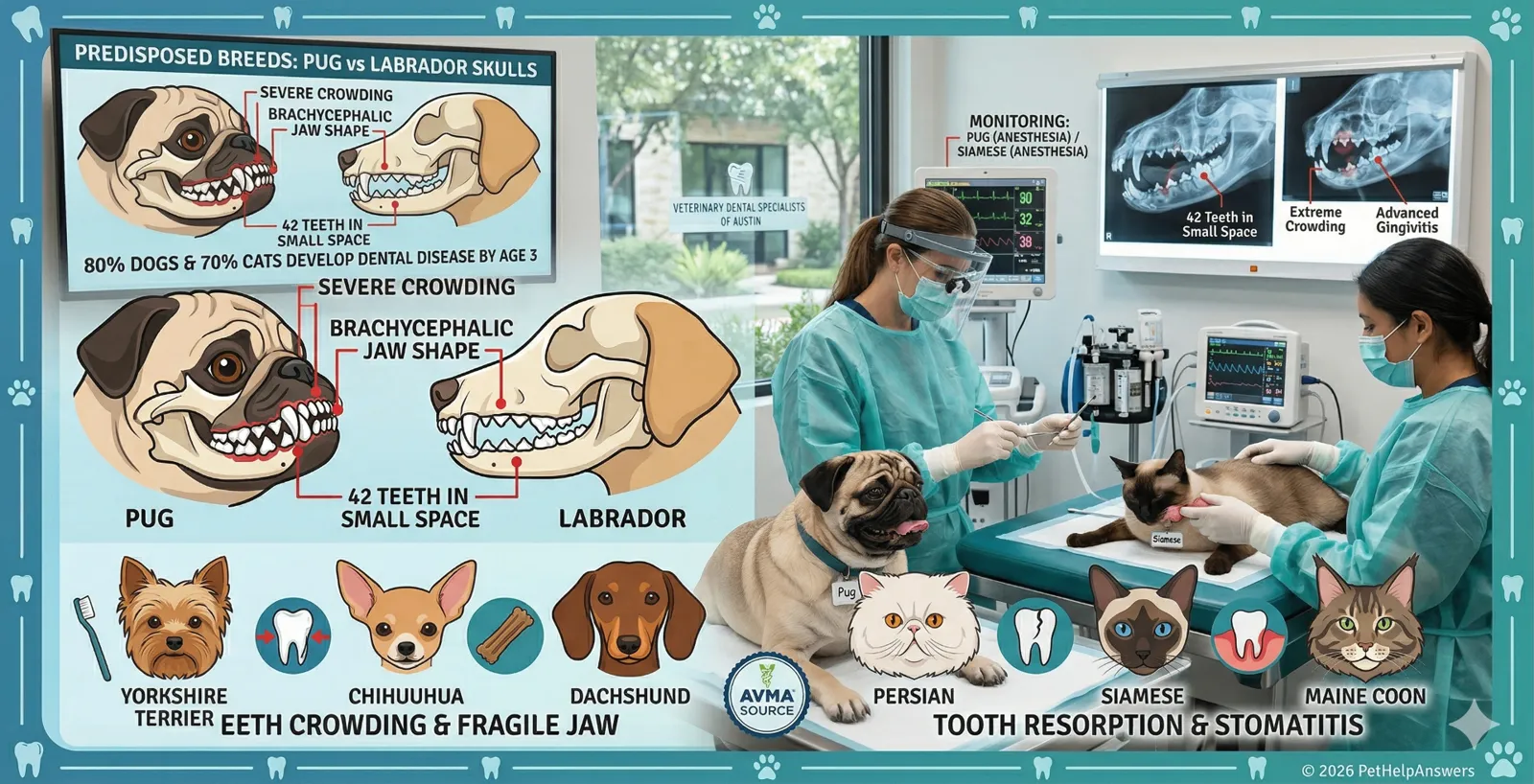
The 27 dog and cat breeds most prone to dental disease are small, toy, and brachycephalic (flat-faced) breeds whose 42 teeth are crowded into undersized jaws — led by Yorkshire Terriers, Toy Poodles, Chihuahuas, Dachshunds, Pugs, and Shih Tzus in dogs, and Siamese, Persian, Maine Coon, and Abyssinian cats. These breeds need daily brushing and professional cleanings starting at age 1 to prevent severe periodontal disease.
Over 80% of dogs and 70% of cats develop dental disease by age 3, according to the American Veterinary Medical Association (AVMA). While all pets are at risk, certain breeds are biologically predisposed due to jaw shape, tooth crowding, or genetic enamel defects. Small and brachycephalic (flat-faced) dogs have the same 42 teeth as a Labrador but a fraction of the jaw space — creating severe crowding that makes dental disease nearly inevitable without proactive care.
Which Dog Breeds Have the Highest Dental Disease Risk?
Small and flat-faced (brachycephalic) dogs are the most affected because they have the same number of teeth (42) as a large Labrador but only a fraction of the jaw space. This "space mismatch" creates thousands of microscopic crevices where bacteria hide.
| Breed | Primary Dental Issues | Risk Level |
|---|---|---|
| Yorkshire Terrier | Retained baby teeth (double rows), severe crowding, rapid tartar | Extreme |
| Poodle (Toy & Mini) | Very narrow jaws leading to early-onset periodontal disease | Extreme |
| Chihuahua | Thin enamel, tooth crowding, fragile jawbones prone to fracture | Very High |
| Dachshund | Deep periodontal pockets along long snouts that trap bacteria | Very High |
| Pug | Rotated teeth due to flat faces; teeth often stack on each other | Very High |
| Shih Tzu | Severe underbites (malocclusion) and delayed tooth eruption | Very High |
| Cavalier King Charles | Heavy plaque buildup and high risk of gingival recession | High |
| Greyhound | Genetic enamel defects and aggressive, early-onset gum disease | High |
| Boxer | Gingival Hyperplasia: excessive gum growth creating infection pockets | High |
| French Bulldog | Misaligned bite and breathing-related dry mouth accelerating decay | High |
| Maltese | Salivary deficiency: saliva less effective at flushing bacteria | High |
| Pomeranian | Retained deciduous (baby) teeth and rapid tartar calcification | High |
| Cocker Spaniel | High incidence of tartar and heavy gum inflammation | Moderate–High |
| English Bulldog | Severe underbite leading to tooth-on-soft-tissue trauma/ulcers | Moderate–High |
| Bichon Frise | Early tooth loss due to weak ligament attachments | Moderate–High |
| Shetland Sheepdog | Lance teeth: upper canines that point forward, causing misalignment | Moderate |
| Labrador Retriever | High risk of fractured teeth from aggressive chewing | Moderate |
Which Cat Breeds Have the Highest Dental Disease Risk?
In cats, the most common breed-specific issues are Tooth Resorption (where the body dissolves the tooth from the inside) and Feline Chronic Gingivostomatitis (FCGS) — a severe immune reaction to plaque that causes extreme pain.
| Breed | Primary Dental Issues | Risk Level |
|---|---|---|
| Siamese | High genetic risk for Tooth Resorption and narrow-jaw misalignment | Extreme |
| Persian | Brachycephalic crowding; flat faces make self-cleaning difficult | Very High |
| Maine Coon | Predisposed to Juvenile Gingivitis and severe periodontal disease | Very High |
| Abyssinian | High prevalence of Gingivostomatitis (chronic, painful mouth sores) | Very High |
| Burmese | Crowded teeth and high incidence of tooth resorption | High |
| Ragdoll | Often develops severe gum inflammation at a very young age | High |
| Devon Rex | Genetic predisposition to chronic gingivitis and early tooth loss | High |
| British Shorthair | Higher-than-average rates of plaque-induced periodontitis | Moderate–High |
| Somali | Similar to Abyssinians; high risk of immune-mediated gum disease | Moderate–High |
| Scottish Fold | General skeletal issues can extend to jaw and tooth abnormalities | Moderate |
What About Mixed Breeds and Mutts?
Mixed breed dogs and cats are NOT immune to dental disease. While "hybrid vigor" can reduce some genetic risks, mixed breeds inherit dental predispositions from their parent breeds. A Chihuahua-Terrier mix still has 42 teeth in a tiny jaw. A Persian-Domestic mix still has brachycephalic crowding.
| Mixed Breed Type | Dental Risk Factors | Risk Level |
|---|---|---|
| Small Mixed Dogs (<20 lbs) | Inherited crowding from small-breed parents, unpredictable jaw-to-tooth ratio | High |
| Medium Mixed Dogs (20–50 lbs) | Depends on parentage — DNA testing reveals inherited risk factors | Moderate |
| Large Mixed Dogs (50+ lbs) | Lower crowding risk, but prone to fractured teeth from chewing | Moderate |
| Brachycephalic Mixes (Flat-Faced) | Any Pug/Bulldog/Shih Tzu mix inherits crowding + dry mouth | Very High |
| Doodle Mixes | Poodle parentage passes narrow-jaw genetics, especially Mini/Toy | High |
| Domestic Shorthair Cat | 70% develop dental disease by age 3; 28–67% get Tooth Resorption | Moderate–High |
| Domestic Longhair Cat | Similar to DSH; longhair around mouth can trap food debris | Moderate–High |
| Siamese/Oriental Mix Cat | Partial heritage carries elevated Tooth Resorption and stomatitis risk | High |
| Persian/Exotic Mix Cat | Brachycephalic jaw structure causes crowding even in mixes | High |
💡 DNA Testing Tip
If you own a mixed breed, a DNA test ($100–$200) can reveal parent breeds and their specific dental predispositions — allowing you to create a targeted prevention plan before disease develops.
Why Are These Breeds Predisposed to Dental Disease?
The Space Mismatch
Small breeds have 42 teeth squeezed into tiny jaws. This crowding creates thousands of microscopic crevices where bacteria hide, making thorough cleaning nearly impossible — even with daily brushing.
Mouth Breathing
Brachycephalic (flat-faced) breeds like Pugs, French Bulldogs, and Persians often breathe through their mouths, drying out the gums. Saliva is a natural disinfectant; without adequate saliva flow, bacteria thrive unchecked.
Genetic Factors
Breeds like Greyhounds have genetically "softer" enamel that erodes faster. Siamese cats have unique immune responses that make them hypersensitive to even small amounts of plaque, triggering tooth resorption.
Look Up Your Breed's Dental Risk
Use the interactive tool below to search for your dog or cat breed and get their specific dental disease risk level, key warning signs, and a tailored prevention plan.
🔍 Breed Dental Risk Lookup
Search 27 dog and cat breeds to see their dental disease risk, specific issues, and prevention plans.
Key Takeaway
Breed-specific preventive dental care costs $150–$250/year — compared to $2,000+ for advanced disease treatment. Daily brushing reduces plaque by 76%, and starting professional cleanings early (age 1 for small breeds) can prevent 95% of severe periodontal disease. Use our Pet Dental Care Guide for the complete at-home routine.
Cleaning $376 (dog) / $430 (cat) avg per CareCredit 2024 benchmarks. Source: CareCredit (2024).
Frequently Asked Questions
What Should You Do Next?
If you own a high-risk breed, start daily brushing today with a VOHC-approved enzymatic toothpaste. Schedule a professional dental evaluation — small breeds should start annual cleanings by age 1. Use the Breed Health Risk Assessor for a complete health profile beyond dental, and review our At-Home Dental Care Guide for step-by-step brushing instructions.