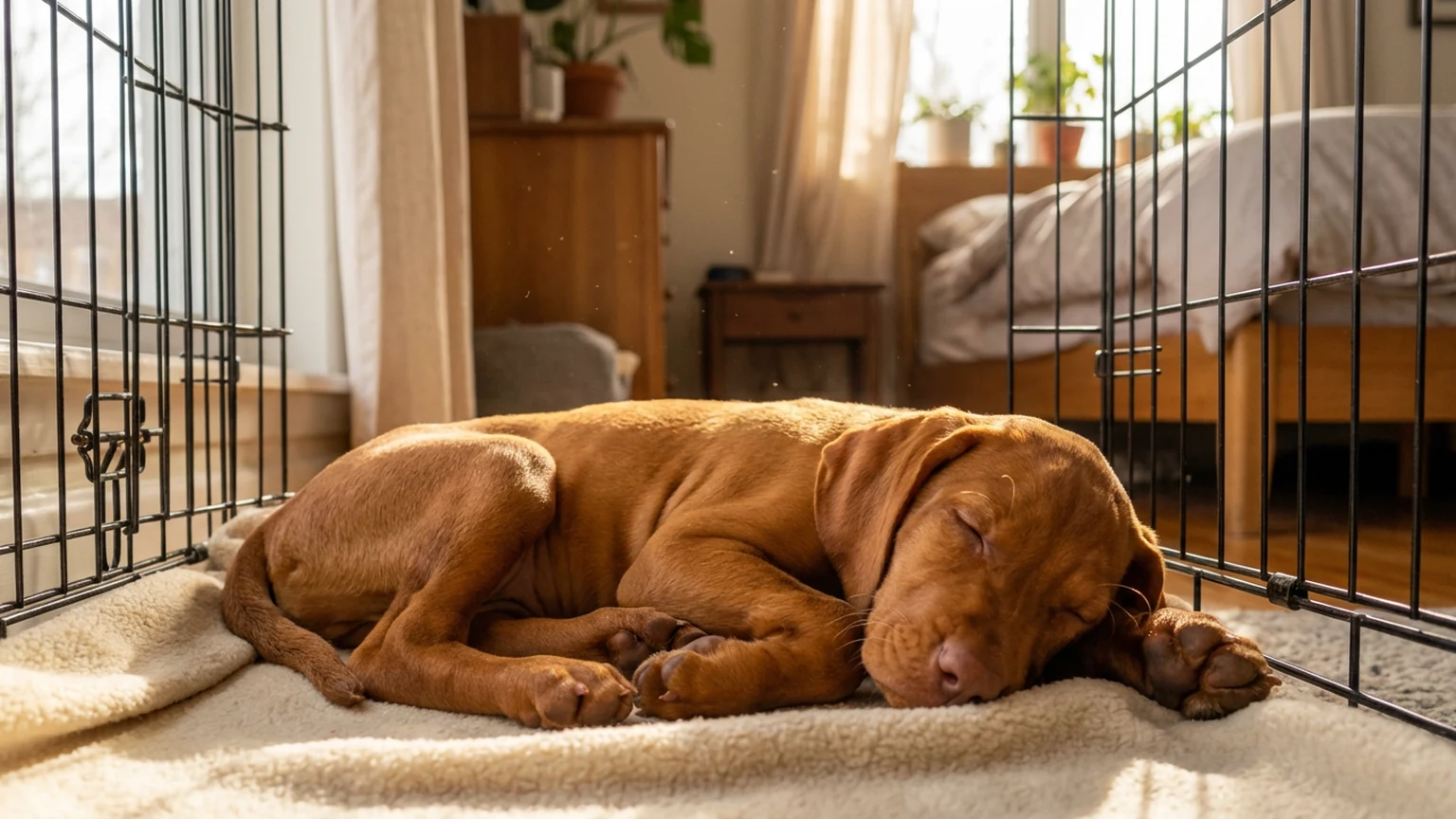
Dogs who are properly crate trained show significantly less destructive behavior and lower separation anxiety symptoms, according to a 2022 study in Applied Animal Behaviour Science and guidelines from the AKC and ASPCA. The crate taps into a dog's natural denning instinct — providing a secure, enclosed space that reduces cortisol levels and promotes rest. However, crating must be introduced gradually and never used as punishment, or it can worsen anxiety and behavioral problems.
Which Type of Crate Is Best for Your Dog?
The AKC recommends matching crate type to your dog's temperament, size, and primary use case. No single crate works for every situation — and using the wrong type can slow training.
| Type | Best For | Limitations | Price Range |
|---|---|---|---|
| Wire Crate | Ventilation, visibility, folding for travel | Heavy; some dogs dislike the openness | $30–$80 |
| Plastic Crate | Airline travel, more enclosed/den-like feel | Less ventilation in warm climates | $25–$70 |
| Soft-Sided | Small dogs, travel, already-trained dogs | Not chew-proof; not for crate training beginners | $30–$60 |
| Furniture Crate | Aesthetics, permanent home placement | Expensive; harder to clean; not portable | $100–$400 |
How Do You Size a Crate Correctly?
The AKC's sizing rule is simple: your dog should be able to stand without touching the top, turn around comfortably, and lie down fully stretched out. For puppies, buy the adult size and use a divider — too much room defeats the housetraining benefit.
| Dog Size | Crate Length | Example Breeds |
|---|---|---|
| Extra Small (up to 10 lbs) | 18–22 inches | Chihuahua, Yorkie, Maltese |
| Small (11–25 lbs) | 24 inches | Beagle puppy, Shih Tzu, Dachshund |
| Medium (26–40 lbs) | 30 inches | Cocker Spaniel, Corgi, Brittany |
| Large (41–70 lbs) | 36 inches | Labrador, Golden Retriever, Boxer |
| Extra Large (71–90 lbs) | 42 inches | German Shepherd, Husky, Standard Poodle |
| Giant (90+ lbs) | 48 inches | Great Dane, Mastiff, Saint Bernard |
What Is the Step-by-Step Crate Training Protocol?
The ASPCA recommends a gradual introduction over 7+ days. Some dogs — especially rescue dogs or anxious breeds — may need 2–4 weeks. Move at your dog's pace, not the calendar's. If your dog shows stress at any step, go back to the previous step and spend more time there.
Door open. Feed all meals inside the crate. Toss treats in randomly. Let the dog explore freely — no closing the door yet. The goal is free, positive association with zero pressure.
Close the door for 10 seconds while the dog eats. Open before they finish. Repeat 5–6 times. If the dog panics, go back to Day 1–2 for another day.
Close the door for 1–5 minutes. Stay nearby. Reward calm behavior through the crate door. Open on calm behavior only — never when whining.
Extend to 10–15 minutes with the door closed. Move a few feet away but stay in sight. Provide a stuffed Kong or long-lasting chew.
Leave the room for 5 minutes with the dog crated. Return calmly — no excited greetings. If the dog was calm, quietly treat and release.
Build up to 30–60 minutes alone. Always provide enrichment (Kong, chew, snuffle mat) for crate time. Extend gradually — rushing this step causes regression.
💡 Key Principle
Every dog progresses at a different speed. The 7-day timeline is a minimum framework — not a deadline. Rescue dogs, anxious breeds, and older dogs who've never been crated may need 3–4 weeks of gradual conditioning. Pushing too fast is the single most common cause of crate training failure.
What Are the Maximum Crate Time Limits by Age?
The AKC and ASPCA both emphasize that a crate is not a storage solution. Exceeding these limits — especially forcing a puppy to soil their crate — destroys the den instinct and creates lasting aversion.
| Age | Max Daytime Crating | Overnight | Notes |
|---|---|---|---|
| 8–10 weeks | ~2 hours (≈1 hour per month of age; very young puppies need ~12 potty breaks daily) | Frequent overnight potty breaks required (AKC) | Per AKC, puppies can hold their bladder roughly one hour per month of age. |
| 11–14 weeks | 1–3 hours | 4–5 hours | Most puppies begin sleeping through the night |
| 15–16 weeks (≈3.5–4 months) | 3–4 hours (caps at ~4 hours daytime per AKC, based on age in months) | Slightly longer due to reduced activity, but the often-cited 6–7 hours lacks direct support | Authoritative guideline (AKC) caps daytime crating at ~4 hours for this age. |
| 6 months+ | Up to 6 hours (1 hour per month of age, up to ~6 hours after 6 months); 10–12 hours is excessive | Generally, dogs shouldn't be left alone more than 6–8 hours | Per AKC: most puppies can hold it ~1 hour per month of age; after 6 months, up to ~6 hours is reasonable. |
| Adult (1 yr+) | See Merck Veterinary Manual on canine behavior problems and treatment (e.g., clomipramine). | See Merck Veterinary Manual on canine behavior problems. | This Merck page discusses behavior problems in dogs and their treatment with medications like clomipramine. |
How Do You Handle Crate Training at Night?
Nighttime is when crating is most effective — and where most new owners struggle. The AKC recommends these evidence-based nighttime protocols:
- Location: Keep the crate in or near your bedroom at night. Your dog should not be isolated in his crate at night — placing it in or near your bedroom helps it feel like a den, gives him the comfort of knowing you're nearby, and provides a quiet resting space. Your dog should also be able to get out of the crate at night to go to the bathroom. If you're training a puppy, set an alarm to take the dog out every few hours; as your puppy can hold his bladder longer, you can increase the time between bathroom breaks (AKC).
- Pre-bed routine: Last potty trip immediately before crating. Wait until the puppy actually eliminates — don't just go outside and come back.
- Set an alarm: The AKC recommends nighttime potty breaks for young puppies that cannot yet sleep through the night, and advises owners to respond calmly if the puppy signals a need (e.g., by keeping the crate in the bedroom). However, AKC guidance does not specify setting an alarm for exactly halfway through the night, nor does it limit this practice to puppies under 12 weeks; general guidance simply emphasizes preparation for nighttime interruptions in very young puppies.
- Whining protocol: Wait for 3–5 seconds of silence before responding. If whining escalates to panic, the puppy may genuinely need a potty break — take them out silently.
- Gradual transition: After 1–2 weeks, slowly move the crate toward its permanent location (2–3 feet per night) if you prefer it outside the bedroom.
How Do You Troubleshoot Whining, Barking & Resistance?
Veterinary behaviorists — including those at the American College of Veterinary Behaviorists (DACVB) — distinguish between normal adjustment whining and true distress. The response should differ:
Mild whining (first few days)
Normal adjustment. Wait for 2–3 seconds of silence, mark it ('good quiet'), then calmly open the door. Never let a dog out while they're actively whining — this teaches whining = door opens.
NormalBarking or demand barking
The dog has learned barking gets attention. Ignore completely (don't even make eye contact). Wait for any pause — even 1 second — and reward the silence. Consistency from ALL family members is critical.
ModerateSustained screaming, drooling, escape attempts
This is panic, not stubbornness. Stop crating immediately and go back to the beginning of the protocol. The claim that 'if panic persists after 2+ weeks of gradual conditioning, consult a veterinary behaviorist' is currently unverifiable based on available authoritative sources — neuroscience and human mental-health literature do not address this exact veterinary timeline (see PMC12280894). Some dogs with isolation distress should not be crated.
SeriousPuppy eliminates inside the crate
Usually means the crate is too large (use a divider), the puppy was crated too long, or there's a medical issue (UTI). Never punish — clean with enzymatic cleaner and shorten the next crate session.
Check setupDog refuses to enter the crate
Go back to step 1: door open, meals inside, treats tossed in casually. Never force, push, or lure and trap. The dog must choose to enter voluntarily. Use high-value treats (cheese, chicken) if kibble isn't motivating enough.
NormalWhen Should You NOT Use a Crate?
Crating is not a universal solution. The ASPCA and DACVB identify several situations where crating is inappropriate or harmful:
Severe separation anxiety
Crating a dog with true separation anxiety (not just boredom) can intensify panic, leading to self-injury, broken teeth, and extreme cortisol spikes. These dogs need a veterinary behaviorist, not a crate.
All-day confinement
extended outdoor confinement — see AKC guidance on how long dogs can safely be outside. If you work long hours, use a dog walker, daycare, or an exercise pen with more space.
As punishment
Sending a dog to the crate as a 'time out' after misbehavior creates a negative association that makes future crate training nearly impossible. The crate must always be a positive space.
Very young puppies (under 8 weeks)
Puppies under 8 weeks (approximately 2 months old) indeed have very limited bladder control, as multiple sources state they cannot fully control their bladders until around 16 weeks (4 months) old (AKC).
How Does Crate Training Support Housetraining?
The AKC identifies the crate as one of the most effective housetraining tools because dogs naturally avoid soiling their sleeping area. But the crate only works for housetraining if sized correctly and time-limited appropriately. Key principles:
- Use a divider so the puppy can't eliminate in one corner and sleep in another
- Take the puppy directly outside immediately after every crate session
- Never exceed the age-based hold time — forcing accidents destroys the den instinct
- Pair crating with a consistent outdoor schedule (same door, same spot, same cue)
- Clean any in-crate accidents with enzymatic cleaner — never ammonia
References
- American Kennel Club — How to Potty Train a Puppy
- American Kennel Club — How Long Can You Leave a Puppy Alone?
- American Kennel Club — Crate Training
- American Kennel Club — How Much Do Puppies Sleep?
- American Kennel Club — How Long Can Dogs Be Outside?
- American Kennel Club — Why Does My Puppy Keep Peeing in the House?
- Merck Veterinary Manual — Behavior Problems of Dogs
- PubMed Central — PMC12280894
Related Guides
Important Notice
This article is for informational purposes only and is not a substitute for professional veterinary advice. Training guidance is based on published recommendations from the AKC, ASPCA, and the DACVB. Dogs with severe separation anxiety should not be crated without guidance from a veterinary behaviorist, as crating can intensify panic in these cases.