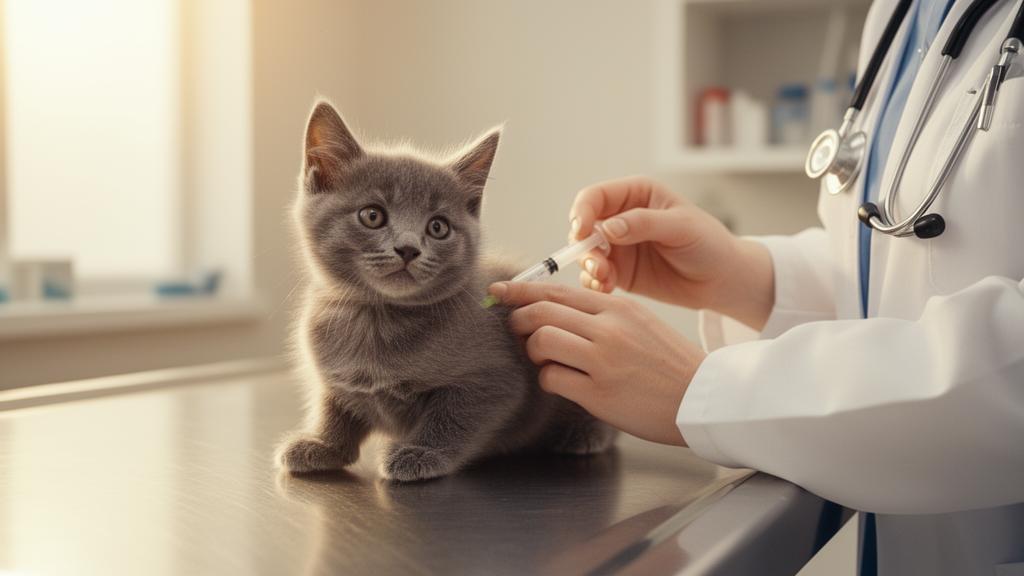
The American Association of Feline Practitioners (AAFP) recommends FVRCP and rabies as core vaccines for all cats — including indoor-only cats — because these diseases are highly contagious and often fatal. Lifestyle vaccines like FeLV are recommended based on individual risk assessment. Modern protocols use 3-year adult boosters and adjuvant-free formulations to maximize safety.
What Are Core vs. Lifestyle Vaccines for Cats?
The AAFP divides feline vaccines into two categories based on disease severity, prevalence, and zoonotic risk:
| Vaccine | Type | Protects Against | Adult Schedule |
|---|---|---|---|
| FVRCP | Core | Herpesvirus, calicivirus, panleukopenia | Every 3 years |
| Rabies | Core | Rabies virus (zoonotic — fatal to humans) | 1 or 3 years (by law) |
| FeLV | Lifestyle (core for kittens) | Feline leukemia virus | Risk-based; annually if outdoor |
| Bordetella | Lifestyle | Upper respiratory infection | Annually if shelter/boarding |
| Chlamydophila | Lifestyle | Chlamydial conjunctivitis | Annually; multi-cat environments |
Why Indoor Cats Still Need Core Vaccines
Panleukopenia virus can survive on surfaces for over a year and be carried indoors on shoes and clothing. Rabies exposure can occur through bats entering the home — a common exposure route. The AAFP recommends core vaccines for all cats regardless of lifestyle.
What Is the Kitten Vaccination Schedule?
Kittens receive maternal antibodies through colostrum, which wane between 6–16 weeks. The series of vaccines ensures protection as maternal immunity fades:
| Age | Vaccines | Additional |
|---|---|---|
| 6–8 weeks | 1st FVRCP | FeLV/FIV test, deworming, fecal exam |
| 10–12 weeks | 2nd FVRCP, 1st FeLV | Deworming, flea prevention discussion |
| 14–16 weeks | 3rd FVRCP, rabies, 2nd FeLV | Spay/neuter scheduling; microchip |
| 1 year | FVRCP booster, rabies booster, FeLV booster | Full wellness exam; dental baseline |
💡 Why the 16-Week Final Dose Matters
Maternal antibodies can block vaccine response in some kittens up to 16 weeks. The final FVRCP dose at 14–16 weeks ensures the kitten develops its own immunity after maternal protection wanes. Skipping this dose leaves a dangerous immunity gap.
How Often Do Adult Cats Need Boosters?
Modern vaccination protocols have moved away from annual boosters for most core vaccines, following AAFP 2024 guidelines:
| Life Stage | FVRCP | Rabies | FeLV | Notes |
|---|---|---|---|---|
| Young adult (1–6 yr) | Every 3 years | Per local law | Risk-based | Titer testing available |
| Mature (7–10 yr) | Every 3 years or titer | Per local law | If still at risk | Discuss risk-benefit with vet |
| Senior (11+ yr) | Titer preferred | Per local law | Case-by-case | Balance immune burden vs. protection |
Are Cat Vaccines Safe? Understanding Side Effects & FISS
Modern feline vaccines are very safe. The AAFP tracks adverse reactions and has driven significant safety improvements:
- Common (mild) — Injection site soreness, mild lethargy, reduced appetite for 24–48 hours
- Uncommon — Mild fever, localized swelling lasting 1–3 days
- Rare — Allergic reaction (facial swelling, vomiting, difficulty breathing) — seek emergency care
- Very rare — Feline Injection-Site Sarcoma (FISS): ~1 in 10,000–30,000 vaccinations with modern adjuvant-free formulations
⚠️ FISS Monitoring Rule
If a lump at an injection site is still present after 3 months, larger than 2 cm, or growing 1 month after vaccination, contact your veterinarian immediately. The "3-2-1 rule" guides when biopsy is warranted. Modern protocols use specific limb injection sites to aid monitoring.
What Is Titer Testing and Should Your Cat Get It?
Titer testing measures antibody levels in the blood to determine if a cat still has protective immunity from previous vaccination. This can help avoid unnecessary boosters:
| Factor | Titer Testing | Standard Booster |
|---|---|---|
| Cost | $60–$150 per test | $25–$50 per vaccine |
| Best for | Senior cats, cats with vaccine reactions, owners wanting minimal vaccination | Healthy adults on standard schedule |
| Limitation | Measures antibodies only; cell-mediated immunity not tested | May vaccinate a cat that already has immunity |
| Available for | FVRCP (panleukopenia most reliable) | All core and lifestyle vaccines |
How Much Do Cat Vaccines Cost in 2026?
| Service | Typical Cost | Notes |
|---|---|---|
| FVRCP (per dose) | $25–$50 | 3 doses for kitten series |
| Rabies | $15–$35 | PureVax (non-adjuvanted) may cost more |
| FeLV (per dose) | $25–$50 | 2 doses for initial series |
| Full kitten series | $200–$400 | Including exam fees |
| Adult annual visit | $100–$200 | Exam + any due boosters |
| Bordetella | $36 |
| Feline chlamydia vaccine | $42 |
| Feline leukemia (FeLV) | $42 |
| FVRCP | $32 |
| Rabies | $30 |
For illustrative purposes — actual costs vary by region, clinic, and pet. Source: CareCredit (2024).
Related Reading
References
- American Association of Feline Practitioners (AAFP) — Feline Vaccination Guidelines (2024)
- American Animal Hospital Association (AAHA) — Feline Vaccination Recommendations (2024)
- Cornell Feline Health Center — Feline Vaccines: Benefits and Risks (2025)
- Vaccine-Associated Feline Sarcoma Task Force (VAFSTF) — Injection-Site Sarcoma Guidelines (2023)
- Journal of Feline Medicine and Surgery — Duration of Immunity in Cats Vaccinated with FVRCP (2022)
- World Small Animal Veterinary Association (WSAVA) — Vaccination Guidelines for Companion Animals (2024)