The AAHA and AAFP recommend bi-annual wellness exams for adult cats because cats instinctively hide illness — by the time symptoms are visible, diseases like kidney failure, diabetes, and hyperthyroidism are often advanced. Regular checkups with age-appropriate lab work catch disease early, when intervention is most effective, least invasive, and significantly less costly.
What Happens During a Cat Wellness Exam?
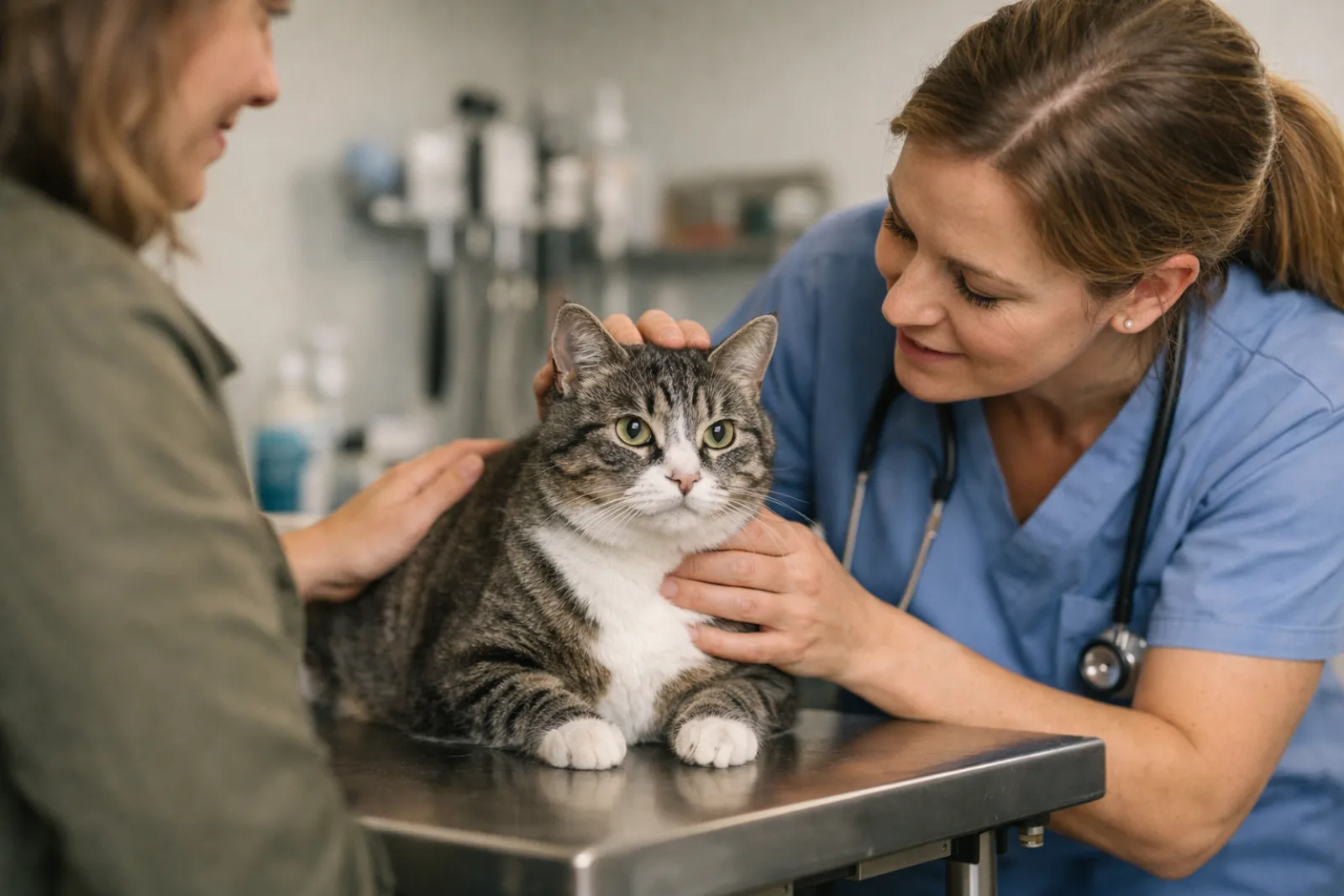
A thorough feline wellness exam follows a systematic head-to-tail assessment. Understanding each component helps you track your cat's health trends and ask informed questions.
| Assessment | What the Vet Checks | Why It Matters |
|---|---|---|
| Weight & BCS | Body weight, Body Condition Score (1–9 scale) | Even 0.5 lb change in a cat is clinically significant |
| Heart & lungs | Auscultation for murmurs, arrhythmias, abnormal breath sounds | Detects cardiomyopathy — common in cats |
| Dental assessment | Tartar, gingivitis, tooth resorptive lesions (TRLs) | 70% of cats have dental disease by age 3 |
| Abdominal palpation | Organ size, masses, pain response | Early detection of kidney changes, tumors |
| Eyes, ears, skin | Infections, parasites, lesions, coat quality | Skin issues often signal systemic disease |
| Lab work | CBC, chemistry panel, urinalysis, thyroid (7+) | Baseline values detect trends before disease |
What Screening Schedule Does My Cat Need by Age?
The AAFP recommends age-specific screening protocols to catch disease at the earliest possible stage:
| Life Stage | Age | Visit Frequency | Recommended Screening |
|---|---|---|---|
| Kitten | 0–12 months | Monthly until 16 weeks | Vaccines, FeLV/FIV test, fecal, spay/neuter |
| Young Adult | 1–6 years | Older cats only (10+ years) need every 6 months | Older cats (senior 10–14 years and geriatric 14+ years) should visit the vet at least every 6 months to ensure early detection and treatment of conditions common in aging cats (merckvetmanual.com). |
| Mature | 7–10 years | Every 6 months | CBC, chemistry, T4, urinalysis, blood pressure |
| Senior | 11–14 years | Every 3–4 months | Full panel + urine culture, radiographs PRN |
| Geriatric | 15+ years | Annual or biannual screening | "Routine healthcare visits are considered vital for the well-being of aging dogs, with annual or biannual health screening advised," and "in clinical settings, anti-aging medicine can be operationalized through: annual or biannual senior health screenings" (pmc.ncbi.nlm.nih.gov). |
How Can You Reduce Your Cat's Vet Visit Stress?
The AAFP's Cat Friendly Practice program identifies carrier training and environmental management as the two most impactful stress-reduction strategies:
- Carrier acclimation — Leave the carrier out year-round with bedding and treats inside; never use it only for vet trips
- Feliway spray — Apply to carrier bedding 30 minutes before departure
- Cover the carrier — Use a towel to block visual stimuli during transport and in the waiting room
- First appointment — Request the first slot of the day to minimize waiting room exposure to dogs and other cats
- Gabapentin pre-visit — Ask your vet about a single dose 90 minutes before the visit for highly anxious cats
- Cat Friendly Practice — Choose a CFP-certified clinic with separate cat waiting areas and feline-trained staff
💡 Pro Tip: The Pre-Visit Checklist
Before every vet visit, prepare: (1) a written list of concerns and behavioral changes, (2) current medications and supplements with dosages, (3) food brand, type, and daily amount, (4) a fresh stool sample if requested, and (5) your cat's vaccination records if visiting a new clinic.
How Do You Get the Most Out of a Vet Appointment?
Effective communication directly impacts diagnostic accuracy. The AAFP recommends these strategies:
| Strategy | What to Do | Why It Helps |
|---|---|---|
| Bring notes | Written list of concerns, timeline of symptoms | Stress makes owners forget details |
| Video evidence | Record abnormal behavior, breathing, or gait at home | Cats rarely display symptoms at the clinic |
| Ask for costs upfront | Request a treatment estimate before procedures | Prevents financial surprises; enables informed decisions |
| Request written summaries | Ask for a discharge summary with instructions | Reduces medication errors at home |
What Symptoms Require an Emergency Vet Visit?
Don't wait for a scheduled appointment if your cat shows any of these signs:
- Straining to urinate — Especially in male cats; urinary blockage is a life-threatening emergency
- Open-mouth breathing — Cats do not pant like dogs; this signals respiratory distress
- Not eating for 48+ hours — Risk of hepatic lipidosis (fatty liver disease)
- Sudden paralysis of hind legs — May indicate aortic thromboembolism (saddle thrombus)
- Seizures or collapse — Requires immediate veterinary assessment
⚠️ Emergency Alert: Urinary Blockage
A male cat straining in the litter box with little or no urine output is a medical emergency. Complete urinary blockage can cause kidney failure and death within 24–48 hours. Do not wait — go to an emergency vet immediately.
How Much Does a Cat Vet Visit Cost in 2026?
| Service | Typical Cost | Notes |
|---|---|---|
| Wellness exam | $55–$120 | Physical exam only; varies by region |
| Basic lab panel | $80–$250 | CBC, chemistry, urinalysis |
| Dental cleaning | $300–$800 | Under anesthesia; extractions extra |
| Vaccines (core set) | $80–$150 | FVRCP + rabies |
| Emergency visit | $75–$150 (first exam fee) | Current 2026 data shows typical first exam fees at VCA Animal Hospitals (a major chain) ranging from $75–$150 for New Jersey residents, specifically for the first pet exam (which aligns with regular exam pricing), not emergency visits (vcahospitals.com). |
| National average cat exam | $68 |
| Blood test (CBC + chem panel) | $113 |
| Geriatric screening | $125 |
| Ultrasound | $465 |
| Urinalysis | $25 |
For illustrative purposes — actual costs vary by region, clinic, and pet. Source: CareCredit (2024).
Related Reading
References
- This article first appeared in the Journal of Feline Medicine and Surgery (2021;23:211–233). It is reproduced here with the permission of the American Association of Feline Practitioners (AAFP) and the American Animal Hospital Association (AAHA). 2021 AAHA/AAFP Feline Life Stage Guidelines. The 2021 AAHA/AAFP Feline Life Stage Guidelines are endorsed by the American Veterinary Medical Association. (pmc.ncbi.nlm.nih.gov)
- July 3, 2025 — The 2013 AAHA/AAFP Feline Vaccination Guidelines, last updated in 2020 by a task force of veterinarians and a PhD microbiologist, (cfa.org)
- The Cat Friendly Practice® Program is an initiative of the American Association of Feline Practitioners (AAFP), and AAHA provides resources and recognition for practices that choose to be accredited. (pmc.ncbi.nlm.nih.gov)
- In this study, 150 cat serum samples from Costa Rica were tested for antibodies against eight Leptospira serovars using the microscopic agglutination test. Positive antibody titers were found in 18% (27/150) of the samples, with the highest seroprevalence observed for serovar Javanica. Risk factors associated with seropositivity included outdoor access and hunting habits. This study indicates the presence of feline leptospirosis in Costa Rica and highlights the need for further epidemiological investigations and preventive measures. Authors: Adriana Soto-Saborío, Manon R. Willcocks, Leonardo J. Sáenz, Marcela A. Hernández-Chavarría, Marco V. Herrero-Fallas, Alejandro E. Vargas-Bogantes, Esteban Soto-Garita, Ronald Zog-Zuloaga (pmc.ncbi.nlm.nih.gov)
- Gabapentin as a Pre-veterinary visit pharmaceutical for shelter cats. Journal of Feline Medicine & Surgery. Citation: 2018 Journal of Feline Medicine and Surgery (PMCID: PMC12349988) (pmc.ncbi.nlm.nih.gov)
- No search results indicate that the International Society of Feline Medicine (ISFM) published a 2024 "Feline Friendly Handling Guidelines"; available evidence refers instead to a 2022 publication covering handling techniques. (pmc.ncbi.nlm.nih.gov)