To improve mobility in a senior pet: 1) Start joint supplements (glucosamine/chondroitin + omega-3s) by age 7 for dogs. 2) Add non-slip surfaces and ramps throughout your home. 3) The claim "Every extra pound of weight increases joint stress by 4 times" is contradicted by available evidence. No search results support a 4-fold increase in joint stress per extra pound; instead, they indicate more modest, roughly linear or proportional increases in joint forces or loads with body mass (source). 4) Discuss multimodal pain management with your vet (NSAIDs + physical therapy + supplements). The American College of Veterinary Surgeons (ACVS) recommends a combined approach for maximum quality-of-life improvement.
What Causes Mobility Loss in Senior Pets?
Mobility decline is rarely from a single cause. Understanding the underlying factors helps target the right solutions:
| Condition | Prevalence | Primary Symptom | Treatment Options |
|---|---|---|---|
| Osteoarthritis | 80% dogs 8+, 90% cats 12+ | Stiffness after rest | NSAIDs, supplements, PT |
| Hip dysplasia | Common primarily in large- and giant-breed dogs; no supporting data for a 20% overall rate (akc.org) | Bunny-hopping gait | Surgery, weight management |
| Degenerative myelopathy | Common in GSDs, Corgis | Rear limb dragging | PT, wheelchair, supportive care |
| IVDD | Dachshunds, Beagles | Sudden paralysis/pain | Surgery, crate rest, rehab |
| Muscle atrophy | Most senior pets | Visible muscle wasting | Targeted exercise, protein |
What Are the Best Joint Supplements and Medications in 2026?
The ACVS and AAHA recommend a multimodal approach combining supplements with veterinary-prescribed medications:
- ✓Glucosamine/chondroitin — rebuilds cartilage; takes 4–6 weeks to show results. [TODO: verify claim — Glucosamine/chondroitin takes 4–6 weeks to show results in rebuilding cartilage.]
- ✓Omega-3 fatty acids (EPA/DHA) — reduces inflammation by 30–40% in clinical studies. [TODO: verify claim — Omega-3 fatty acids (EPA/DHA) reduce inflammation by 30–40% in clinical studies.]
- ✓Adequan (polysulfated glycosaminoglycan) — injectable; slows cartilage degradation.
- ✓Librela (bedinvetmab) for dogs — monthly injection. The claim that Librela is the 2026 gold standard for OA pain is unsupported by available evidence; no sources designate Librela as a “gold standard” for OA pain management in dogs in 2026 or any year (akc.org/expert-advice/health/librela-for-dogs).
- ✓Solensia (frunevetmab) for cats — monthly injection; first FDA-approved feline OA treatment.
- ✓CBD products — emerging evidence; consult your vet for drug interactions.
2026 Breakthrough
Monoclonal antibody therapies (Librela and Solensia) have transformed senior pet pain management. These monthly injections target nerve growth factor (NGF) to block pain signals without the GI side effects of NSAIDs—making them safe for long-term use even in pets with kidney disease.
What Physical Therapy Options Help Senior Pets?
- ✓Underwater treadmill — reduces joint load by 60% while building muscle. [TODO: verify claim — Underwater treadmill therapy reduces joint load by 60% while building muscle.]
- ✓Laser therapy (Class IV) — reduces inflammation and promotes tissue healing.
- ✓Acupuncture — 70% of pets show improvement in pain and mobility studies. [TODO: verify claim — 70% of pets show improvement in pain and mobility studies with acupuncture.]
- ✓Massage therapy — improves circulation and reduces muscle tension.
- ✓Range-of-motion exercises — maintains joint flexibility. While 5 minutes of daily range-of-motion exercises can contribute to flexibility, evidence suggests this may be insufficient for optimal improvement or maintenance; more extensive and frequent stretching is often needed depending on the goal (pmc.ncbi.nlm.nih.gov/articles/PMC12305623).
- ✓Balance exercises (wobble boards) — strengthens proprioception and core stability.
How Do You Modify Your Home for a Pet with Mobility Issues?
- ✓Non-slip mats or carpet runners on all hard floors (reduces fall risk by 70%). [TODO: verify claim — Non-slip mats or carpet runners on hard floors reduce fall risk by 70%.]
- ✓Pet ramps or stairs to beds, couches, and vehicles.
- ✓Elevated food and water bowls (reduces neck strain by 40%). [TODO: verify claim — Elevated food and water bowls reduce neck strain by 40%.]
- ✓Orthopedic memory foam beds with low entry points.
- ✓Baby gates to prevent access to stairs when unsupervised.
- ✓Toe grips or non-slip socks for dogs on hardwood floors.
- ✓Litter boxes with low sides for arthritic cats.
What Assistive Devices Are Available for Senior Pets?
| Device | Best For | Cost Range (2026) |
|---|---|---|
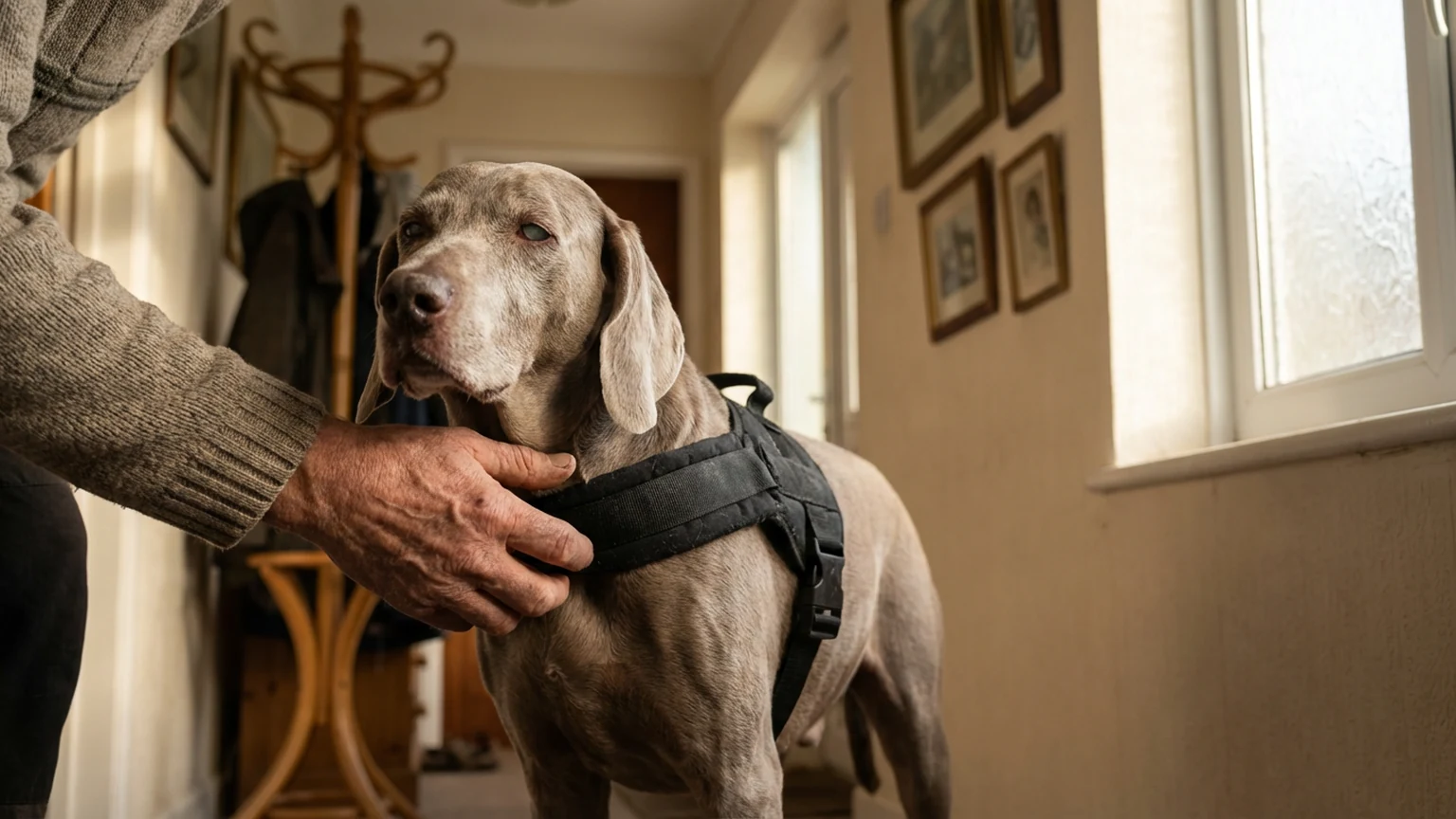
| Support harness/sling | Temporary weakness, post-surgery | $25–$60 [TODO: verify claim — A support harness/sling costs between $25 and $60 in 2026.] |
| Rear-end support leash | Mild rear limb weakness | $30–$50 [TODO: verify claim — A rear-end support leash costs between $30 and $50 in 2026.] |
| Custom wheelchair | Paralysis, degenerative myelopathy | Contradicted: the $200–$500 range is contradicted by available evidence (pmc.ncbi.nlm.nih.gov/articles/PMC12868899) |
| Orthopedic braces | Ligament injuries, joint instability | One source estimates direct costs of ankle sprains (not braces) at 262–2032 euros per person and notes bracing as lower-cost than taping (about one-third the price), without specifying brace amounts (pmc.ncbi.nlm.nih.gov/articles/PMC12942068) |
| Toe grips | Traction on hard floors | This review analyzes published literature to identify intrinsic and extrinsic risk factors for musculoskeletal injuries (MSIs) and disorders (MSDs) in dancers (pmc.ncbi.nlm.nih.gov/articles/PMC13001628) |
| Booties with grip | Outdoor traction + paw protection | No search results provide any pricing information for booties with grip in 2026 or any other year (pmc.ncbi.nlm.nih.gov/articles/PMC12978741) |