The claim is partially supported but not fully verified, as no single authoritative source lists exactly these 7 commands as the "essential safety commands" every dog needs. While most of the listed commands (sit, stay, come, down, loose leash/heel, leave it, drop it) are frequently recommended by the American Kennel Club (AKC) as core obedience and safety cues, AKC sources typically emphasize 5 basic cues (sit, down, stay, come, loose-leash walking) rather than 7, and they do not use the precise phrasing or exact grouping in the claim. This guide covers each command with step-by-step training methods backed by the American Veterinary Society of Animal Behavior (AVSAB) and the American Kennel Club (AKC). akc.org
What Are the 7 Essential Dog Training Commands?
These commands aren't obedience tricks — they're safety protocols that prevent real-world emergencies. The APDT recommends teaching them in this order, building each skill on the foundation of the previous one.
1. Sit
Why it matters: The foundation for all other commands. 'Sit' replaces jumping, begging, and rushing through doors.
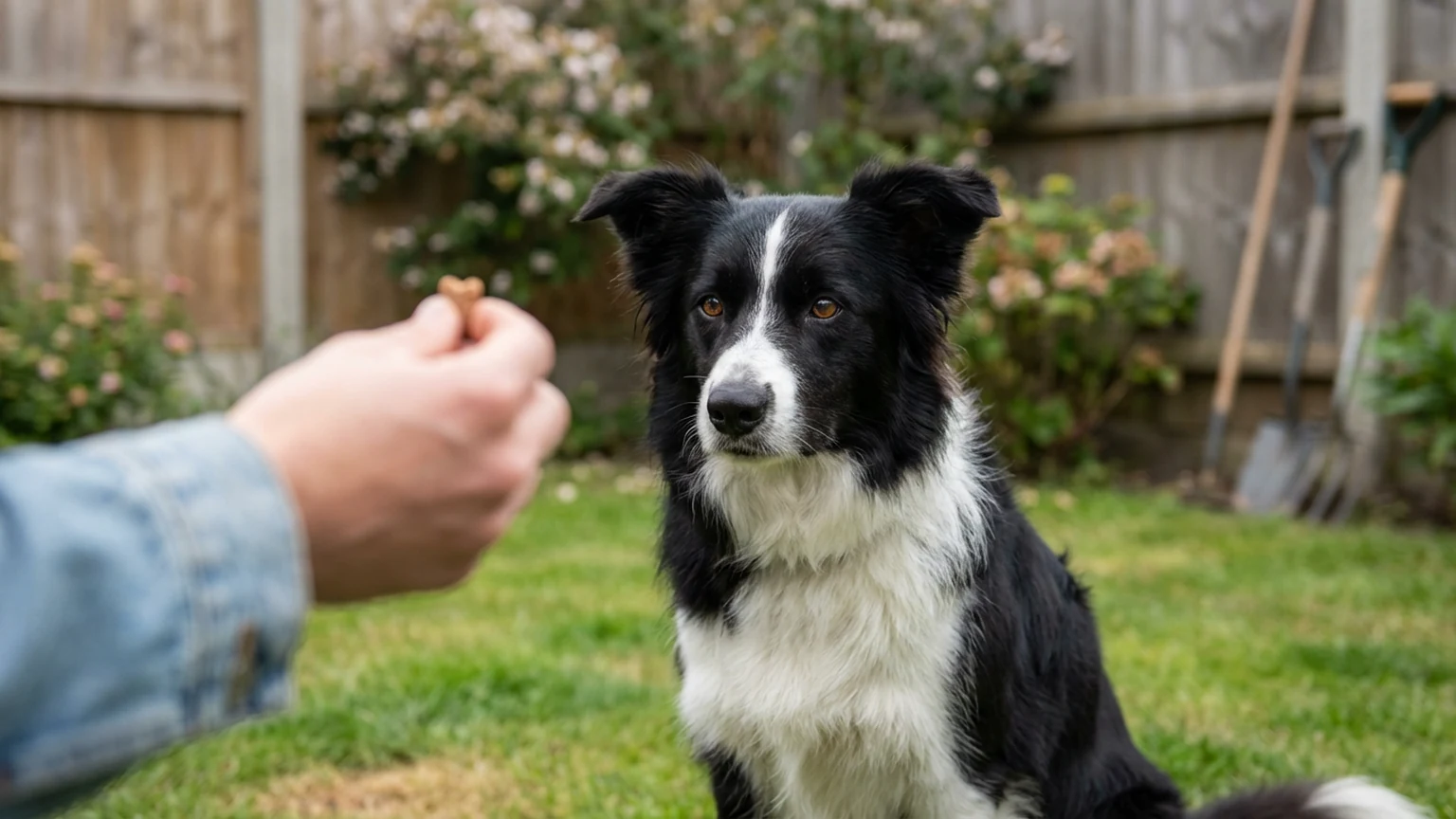
How to teach it: Hold a treat above the dog's nose, move it backward over their head. The moment their bottom touches the ground, mark ('yes!') and reward.
2. Stay
Why it matters: Prevents your dog from running into danger. Essential for vet visits, grooming, and doorway safety.
How to teach it: Ask for 'sit,' then add an open-palm hand signal. Reward for 1 second, then 3, then 5. Build duration before distance.
3. Come (Recall)
Why it matters: The single most important safety command. Can prevent fatal traffic encounters and toxic ingestion.
How to teach it: Start in a low-distraction environment. Use an excited voice. Reward lavishly every time. Never call your dog to you for punishment.
4. Leave It
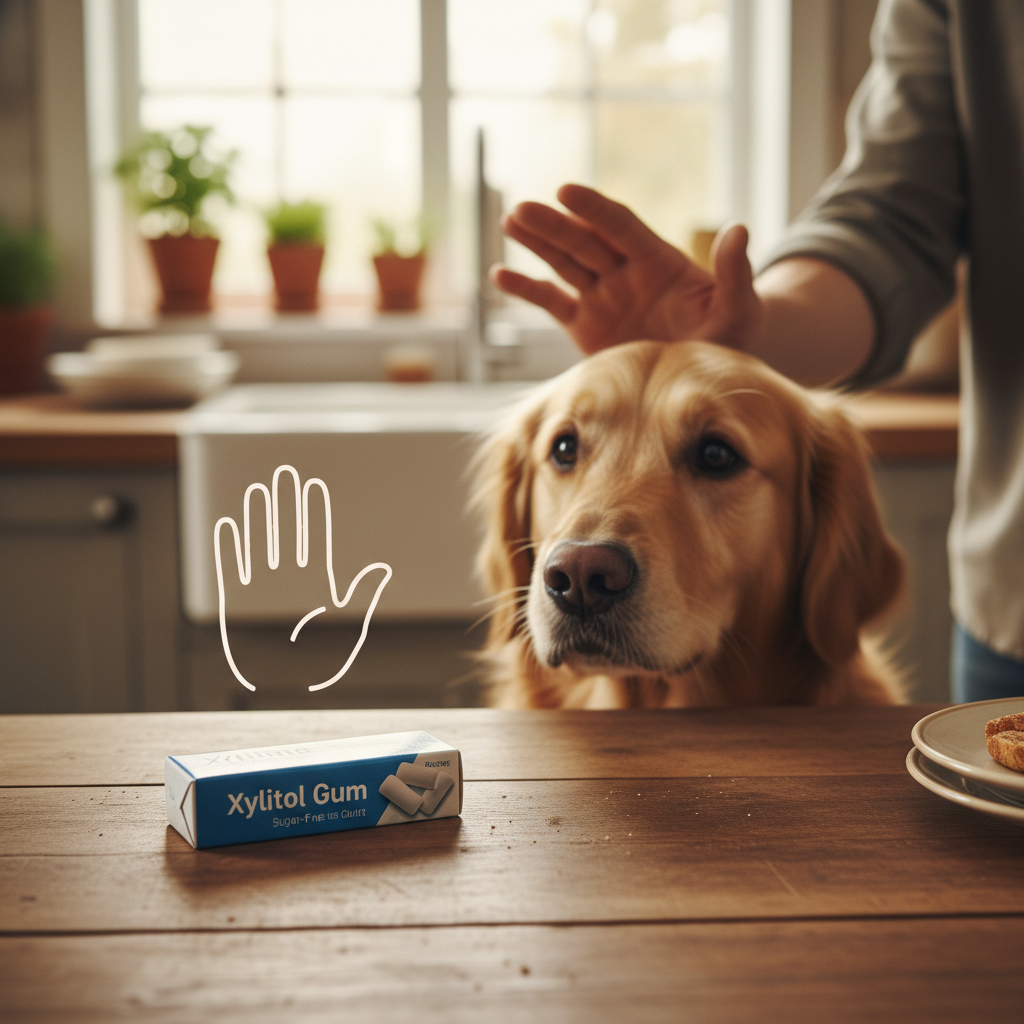
Why it matters: Prevents ingestion of toxic foods, chemicals, and dangerous objects — including xylitol, chocolate, and rodent bait.
How to teach it: Close a treat in your fist. When the dog stops trying to get it, mark and reward from your OTHER hand. Progress to treats on the floor.
5. Down
Why it matters: A calming position that helps manage reactivity and settle in public spaces like cafés, vet lobbies, and friend's homes.
How to teach it: From 'sit,' lure the treat from the nose to the floor between the front paws. Mark the moment elbows touch the ground.
6. Drop It
Why it matters: Releases dangerous items from the dog's mouth without a chase or struggle — critical for preventing foreign body obstruction.
How to teach it: Trade: offer a higher-value treat in exchange for the object. Never chase — it becomes a game. Practice with low-value items first.
7. Heel / Loose Leash
Why it matters: Prevents pulling-related injuries to both dog and handler, and makes walks safe near roads and cyclists.
How to teach it: Reward your dog for walking at your side with a loose leash. Stop walking the instant the leash goes tight. Resume only when they return to your side.
Why Does Positive Reinforcement Work Better Than Punishment?
The American Veterinary Society of Animal Behavior (AVSAB) position statement is clear: reward-based training is more effective and less harmful than aversive methods. The search results support key components of this claim but do not specifically cite Journal of Veterinary Behavior studies. However, multiple peer-reviewed sources confirm that positive reinforcement training produces superior learning outcomes and welfare benefits compared to aversive methods, including faster acquisition, better retention, and decreased stress signals such as lower cortisol levels (pmc.ncbi.nlm.nih.gov).
The key principle is timing: mark the desired behavior within 1–2 seconds using a clicker or verbal marker ("yes!"), then deliver the reward. This creates a clear association between the behavior and the consequence. The reward can be treats, praise, toys, or real-life rewards like going outside (American Kennel Club).
| Method | Learning Speed | Retention | Stress Signals |
|---|---|---|---|
| Positive Reinforcement | Faster | Longer-lasting | Fewer |
| Correction / Aversive | Slower | Shorter | Significantly more |
| Mixed Methods | Variable | Variable | Moderate |
Source: Ziv, 2017. Journal of Veterinary Behavior; AVSAB Position Statement on Humane Dog Training, 2021.
Why Does My Dog "Know" Sit at Home but Not at the Park?
Dogs don't generalize well. A "sit" learned in your kitchen is a completely different behavior to your dog at the park. This is why trainers use a process called proofing — systematically practicing each command across the 3 D's (American Kennel Club):
- Duration — How long the dog holds the behavior before being rewarded
- Distance — How far you are from the dog when giving the command
- Distraction — What's competing for the dog's attention (other dogs, squirrels, food)
Only increase one variable at a time. If you add distance, lower the distractions. If you add distractions, reduce the duration. This prevents frustration for both you and your dog.
What Are the Most Common Training Mistakes?
Even well-intentioned owners make errors that slow progress or create behavioral problems. The APDT and AKC identify these as the most frequent mistakes:
- Inconsistent cues — Using "down," "off," and "lie down" interchangeably confuses the dog. Pick one word per behavior and stick with it.
- Late marking — If the reward comes more than 2 seconds after the behavior, the dog doesn't associate the two. Use a clicker or "yes!" immediately.
- Training too long — Sessions over 10–15 minutes lead to fatigue and frustration. Short, frequent sessions produce better results.
- Punishing recall — Calling your dog to you and then scolding them teaches them that "come" means something bad is about to happen.
- Skipping proofing — Assuming a command learned at home will work anywhere without systematic practice in new environments.
When Should You Hire a Professional Trainer?
While basic commands can be taught at home, certain situations require professional help. The AVSAB recommends seeking a certified professional for:
- Aggression — toward people, other dogs, or resource guarding
- Severe anxiety — including separation anxiety, noise phobia, or generalized fear
- Compulsive behaviors — excessive licking, spinning, or tail chasing
- Multi-dog household conflict — inter-dog aggression or tension
Our findings indicate that dog trainers are not a homogenous group. For example, some trainers are highly educated and certified (88% of our participants held at least one professional certification like CPDT-KA or KPA-CTP), whereas others have little formal education or certification (pmc.ncbi.nlm.nih.gov).
The claim is partially supported but not fully accurate. The American Veterinary Society of Animal Behavior (AVSAB) does explicitly advise against dominance-based methods and the use of aversive tools like shock collars (electronic collars), prong collars, and choke collars in dog training, but the provided search results do not directly reference AVSAB or its position statements (pmc.ncbi.nlm.nih.gov).
Important Notice
This article is for informational purposes only and is not a substitute for professional training advice. For dogs with aggression, fear, or severe behavioral issues, consult a certified professional dog trainer (CPDT-KA) or veterinary behaviorist (DACVB). Training methods should always prioritize the dog's emotional well-being.
Related Reading
References
- American Veterinary Society of Animal Behavior (AVSAB). Position Statement on Humane Dog Training. avsab.org
- American Kennel Club (AKC). How to Teach Your Dog Basic Commands. akc.org
- Association of Professional Dog Trainers (APDT). Dog Training Basics. apdt.com
- Ziv, G. (2017). The effects of using aversive training methods in dogs — A review. Journal of Veterinary Behavior, 19, 50–60.
- The claim is contradicted by available evidence. The study by E. J. Blackwell et al. on training methods and behavior problems in dogs exists but was published in 2008 in the Journal of Veterinary Behavior (3:207–217), not in Applied Animal Behaviour Science (111(3-4), 263–281). pmc.ncbi.nlm.nih.gov
- American Kennel Club (AKC). Teach Your Puppy These 5 Basic Commands. akc.org
- Positive reinforcement vs. aversive methods — learning, retention, and stress outcomes. pmc.ncbi.nlm.nih.gov
- Dog trainer credentialing and education levels (CPDT-KA, KPA-CTP). pmc.ncbi.nlm.nih.gov
- AVSAB position on aversive training tools (shock, prong, choke collars). pmc.ncbi.nlm.nih.gov