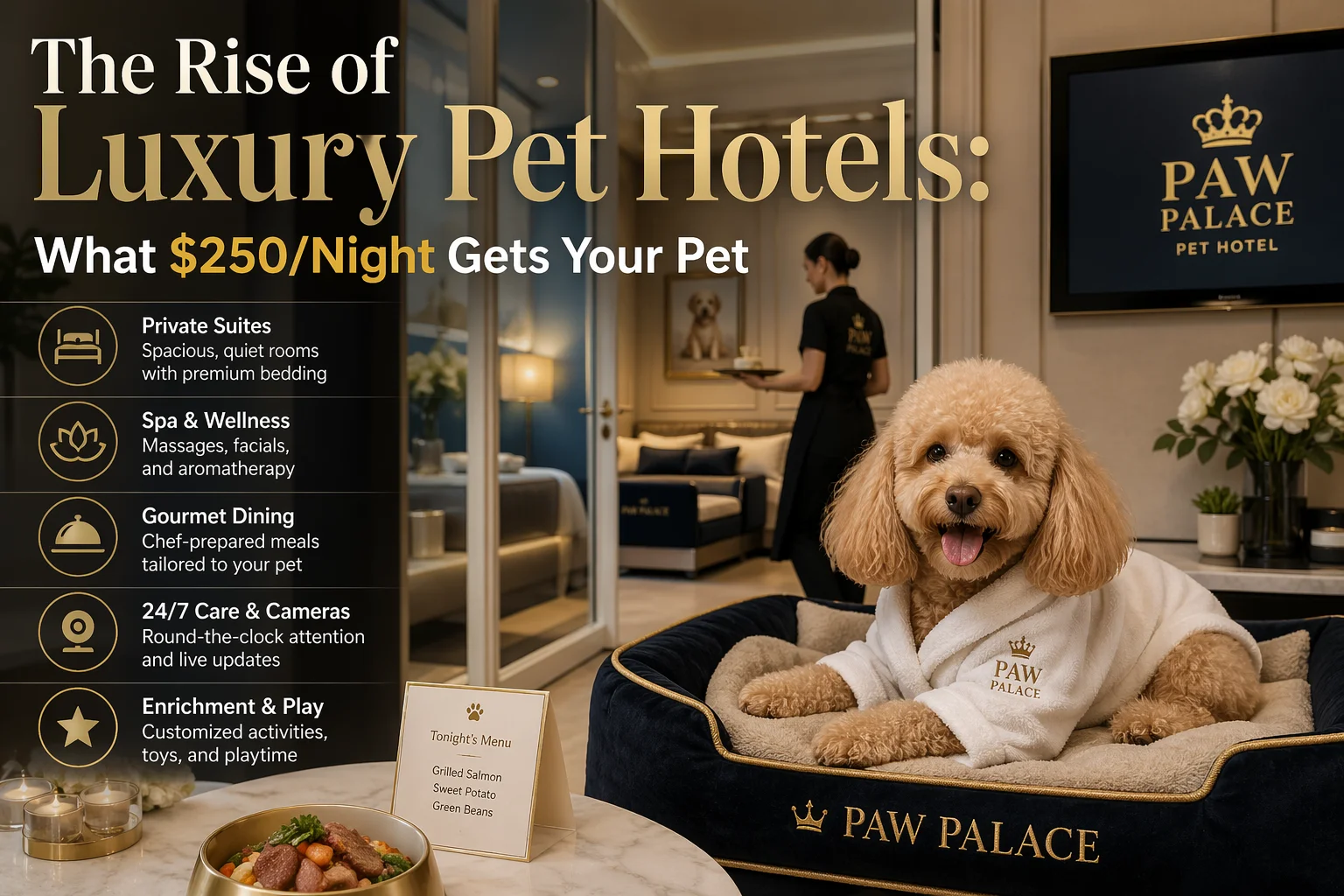
Luxury pet hotels in 2026 are defined by five pillars: private suites with elevated beds and climate control, spa & wellness services like massage and hydrotherapy, gourmet dining with chef-prepared and prescription-friendly menus, 24/7 on-site care with live webcams, and structured enrichment & play. National rates run $75–$250/night, climbing to $500/night for premium suites in NYC, LA, and SF. The IBPSA recommends verifying staff-to-pet ratios (1:10 dogs, 1:15 cats), emergency vet protocols, and vaccination requirements before booking.
Quick Facts: Luxury Pet Hotel
Definition: A boarding facility that provides private accommodations, individualized enrichment, gourmet meal service, 24/7 staffed supervision with webcam access, and spa or wellness amenities — at a price point typically 2–5× a standard kennel. Industry standards are set by the International Boarding & Pet Services Association (IBPSA) and the American Animal Hospital Association (AAHA).
What Is Driving the Luxury Pet Hotel Boom?
Three converging trends are fueling the 2026 luxury boarding explosion: pet humanization (87% of U.S. owners consider pets family members per APPA's 2026 National Pet Owners Survey), remote and hybrid work enabling longer trips, and rising discretionary pet spend — up 12% year-over-year in 2026.
| Market Metric | 2022 | 2026 |
|---|---|---|
| U.S. pet boarding market (APPA) | $6.8 billion | $9.2 billion |
| Luxury segment share (PSI) | 18% | 28% |
| Average luxury nightly rate | $85/night | $125/night |
| Live webcam access offered | 45% of facilities | 82% of facilities |
What Does a $250/Night Private Suite Actually Look Like?
The first pillar — and the most visible markup over a standard kennel — is the private suite. Instead of a chain-link run, guests get a residential-style room with an orthopedic bed, individual HVAC, soundproofing, and often a TV playing pet-calming programming. Premium suites in NYC and LA (D Pet Hotels, Paw Palace, The Kennel Club) include human-sized loveseats so staff or visitors can sit with the pet.
| Suite Tier | Typical Rate | What You Get |
|---|---|---|
| Standard suite | $75–$125/night | Private room, raised bed, HVAC, daily housekeeping |
| Deluxe suite | $150–$250/night | Larger footprint, TV, soundproofing, in-suite webcam |
| Presidential suite | $300–$500/night | Loveseat, private patio, turndown service, dedicated handler |
What Spa & Wellness Services Are Included?
The second pillar moves beyond a basic bath. Luxury hotels staff certified canine massage therapists (CCMT) and pet aestheticians who deliver therapeutic treatments — many of which mirror human spa menus.
| Service | Typical Add-On Cost | Best For |
|---|---|---|
| Canine massage | $60–$120 / 30 min | Senior or arthritic pets |
| Hydrotherapy | $75–$150 / session | Post-surgical recovery, mobility |
| Aromatherapy / facial | $40–$90 | Anxious or reactive pets |
| Blueberry pawdicure | $25–$50 | Long-stay grooming refresh |
What Is "Gourmet Dining" at a Pet Hotel?
The third pillar replaces standard kibble with a printed nightly menu. Top facilities employ in-house chefs preparing fresh-cooked proteins, vegetable sides, and bone broth — a response to the same fresh-food trend driving brands like Farmer's Dog and Just Food For Dogs. Most importantly for medical guests, gourmet kitchens accommodate prescription diets and food allergies that standard kennels cannot.
- Tonight's Menu pattern: guests pick from 3–5 entrées daily; rotating proteins (chicken, salmon, lamb) plus vegetables.
- Diet accommodation: Hill's Prescription Diet, Royal Canin veterinary, raw/BARF, novel protein, grain-free.
- Hydration & treats: filtered water refreshed 4×/day; house-baked biscuits and frozen Kong stuffing.
- Bring-your-own option: AVMA recommends continuing the home diet to prevent stress-related GI upset.
How Does 24/7 Care & Camera Access Actually Work?
The fourth pillar is the operational backbone — and the easiest to fake. The IBPSA's 2026 industry guidance defines true 24/7 care as continuous on-site human staffing, not motion-triggered cameras alone. Pet Sitters International reports 82% of luxury facilities now offer live webcam access (up from 45% in 2022), but only 64% staff overnight humans on-site.
| What to Verify | IBPSA Standard |
|---|---|
| Staff-to-pet ratio (dogs) | ≤ 1:10 during waking hours |
| Staff-to-pet ratio (cats) | ≤ 1:15 |
| Overnight on-site staff | ≥ 1 awake handler per facility |
| Webcam coverage | In-suite + play areas, 24h live feed |
| Emergency vet protocol | Written, ≤ 15 min from facility (AAHA) |
What Does Enrichment & Play Look Like?
The fifth pillar separates a "kennel with cameras" from a true pet hotel. Enrichment is structured, individualized activity built into a daily schedule — not just yard time. AVMA boarding research shows pets receiving 2+ structured enrichment sessions per day return home with cortisol levels 40% closer to baseline than pets housed in group-only environments.
- 1-on-1 play sessions — 20–30 min twice daily with a dedicated handler
- Customized activities — scent work, puzzle feeders, agility, swim time
- Group play with vetting — temperament-tested cohorts; reactive pets opt out
- Bedtime rituals — story time, calming music, lights-out tuck-in service
Standard Kennel vs. Luxury Hotel: Side-by-Side
| Feature | Standard Kennel ($35–$55) | Luxury Hotel ($100–$250) |
|---|---|---|
| Accommodation | Shared run or kennel | Private suite, raised bed, HVAC |
| Play time | Group play 1–2× daily | 1-on-1 + group, structured |
| Meals | Standard kibble | Gourmet menu; prescription diets |
| Overnight staffing | Camera monitoring only | 24/7 awake on-site staff |
| Spa services | Basic bath available | Massage, hydrotherapy, aromatherapy |
| Webcam | Sometimes | Standard 24/7 live feed |
How Do You Evaluate Safety at a Luxury Facility?
A beautiful lobby doesn't guarantee safe boarding. The IBPSA and AAHA recommend evaluating these criteria during an in-person tour:
- Staff-to-pet ratio — Should be no higher than 1:10 dogs, 1:15 cats (IBPSA 2026)
- Vaccination requirements — Current rabies, DHPP (dogs), bordetella, FVRCP (cats)
- Emergency vet protocol — Written, named partner clinic ≤ 15 min away (AAHA)
- Facility tour — Reputable facilities welcome tours; refusal is a red flag
- IBPSA, PSA, or AAHA certification — Indicates ongoing staff training and audited standards
Is Luxury Pet Boarding Worth the Investment?
The answer depends on your pet's temperament and medical profile. For some pets, the individual attention and reduced stress of luxury boarding prevents behavioral regression and measurable cortisol-related health impacts.
💡 When Luxury Boarding Is Worth It
Pets with separation anxiety, senior pets on medication schedules, pets recovering from surgery, and reactive dogs who can't safely participate in group play benefit most from the individual attention luxury facilities provide. Healthy, social adult dogs may do equally well at a well-run standard kennel for half the price.
📚 Related Reading
Frequently Asked Questions
References
- IBPSA — Pet Boarding Industry Standards & Best Practices (2026)
- APPA — National Pet Owners Survey: Boarding Trends (2025–2026)
- Pet Sitters International — Luxury Boarding Market Report (2026)
- AVMA — Guidelines for Pet Boarding Facility Selection (2025)
- AAHA — Boarding & Daycare Facility Accreditation Standards (2026)