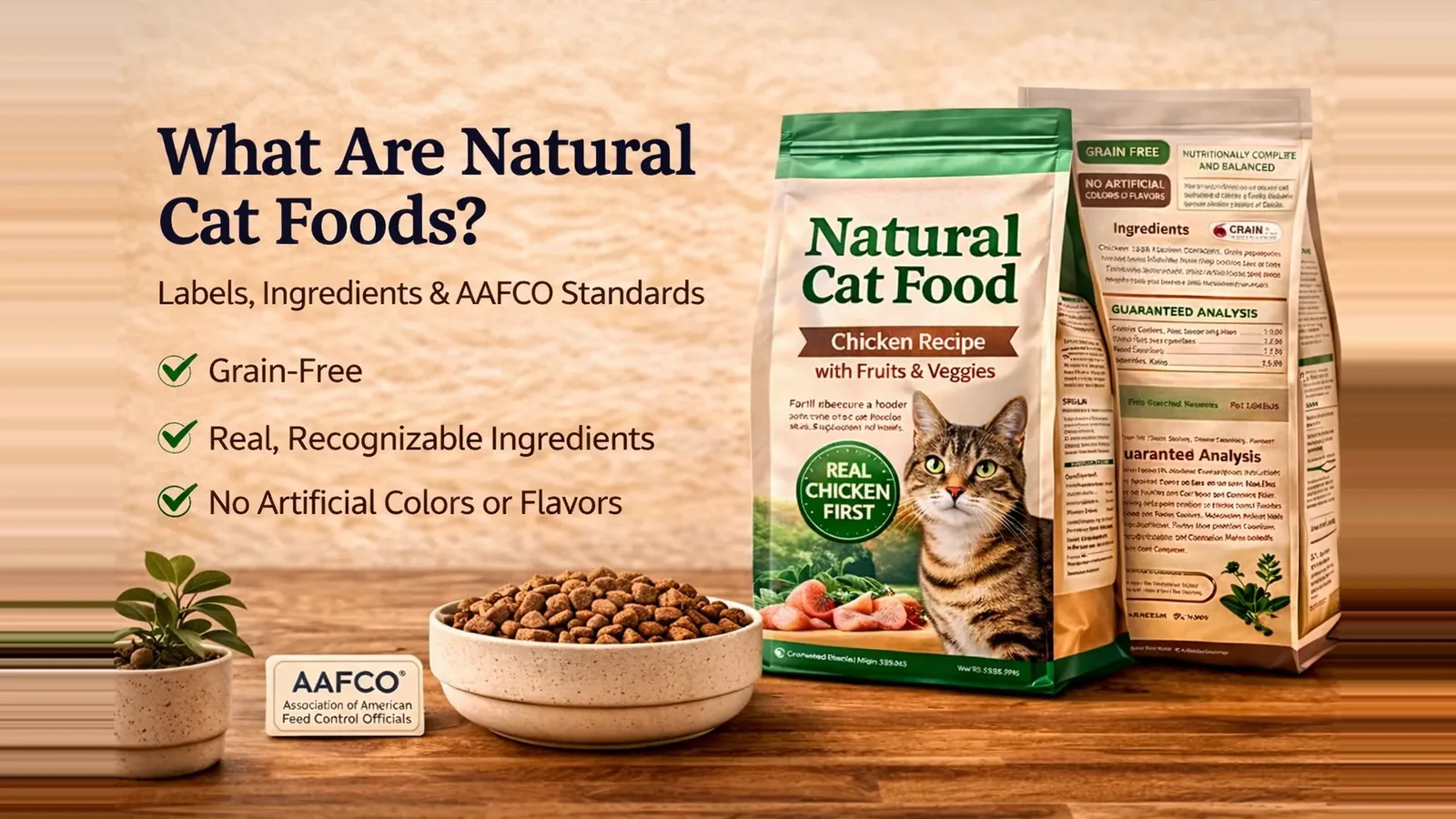
"Natural" cat food is regulated by AAFCO and means every ingredient is derived from plant, animal, or mined sources without chemically synthetic processing — except for added vitamins and minerals (which must be disclosed). It is not the same as organic (a USDA-regulated growing standard) or holistic and premium (marketing terms with no legal definition). The most important label on any cat food is the AAFCO Nutritional Adequacy Statement, which confirms the diet is complete and balanced for a specific life stage.
Pet food marketing has outpaced regulation. The Association of American Feed Control Officials (AAFCO) and the FDA Center for Veterinary Medicine (FDA CVM) jointly govern pet food labeling in the United States, but only a handful of terms are legally defined. According to the WSAVA Global Nutrition Committee and Tufts Petfoodology (the Clinical Nutrition Service at Cummings School of Veterinary Medicine), most consumers focus on the front of the bag, when the meaningful nutritional information is on the back.
What Does "Natural" Actually Mean on a Cat Food Label?
AAFCO defines "natural" as "a feed or ingredient derived solely from plant, animal or mined sources, either in its unprocessed state or having been subject to physical processing, heat processing, rendering, purification, extraction, hydrolysis, enzymolysis or fermentation, but not having been produced by or subject to a chemically synthetic process and not containing any additives or processing aids that are chemically synthetic except in amounts as might occur unavoidably in good manufacturing practices." Synthetic vitamins and minerals are permitted only because nutritionally complete cat foods cannot be formulated without them — and the label must read "natural with added vitamins and minerals."
How Is "Natural" Different From Organic, Holistic, and Premium?
| Term | Regulated By | What It Actually Means |
|---|---|---|
| Natural | AAFCO | No chemically synthetic ingredients except added vitamins/minerals |
| Organic | USDA NOP | Ingredients grown without synthetic pesticides, GMOs, or sewage sludge |
| Human-grade | AAFCO (limited) | Every ingredient AND the manufacturing facility must meet human-food standards |
| Holistic | Not regulated | Marketing term with no legal definition |
| Premium / Super-premium | Not regulated | Marketing term — does not require higher-quality ingredients |
| Gourmet | Not regulated | Marketing term — no nutritional or sourcing requirements |
How Do You Read a Cat Food Ingredient Label?
Cornell Feline Health Center recommends reading every label in this order:
- First ingredient — Should be a named animal protein ("chicken," "salmon," "turkey"), not "poultry by-products" or "meat meal"
- AAFCO Nutritional Adequacy Statement — Confirms "complete and balanced" for a specified life stage; feeding-trial validation is preferred over formulation
- Guaranteed analysis — Minimum crude protein (≥30% dry matter for adult cats), minimum fat (≥9%), maximum fiber, maximum moisture
- Taurine listed — Cats cannot synthesize enough taurine; deficiency causes dilated cardiomyopathy and retinal degeneration
- Manufacturer contact — A reputable brand publishes phone, email, and full nutrient analysis on request (a WSAVA criterion)
Which Ingredients Should You Avoid in Cat Food?
- BHA, BHT, ethoxyquin — Synthetic preservatives; ethoxyquin is restricted in human food. Mixed tocopherols (vitamin E) are the natural alternative.
- Artificial dyes — Red 40, Yellow 5, Blue 2; serve no nutritional purpose for cats and are flagged by Tufts Petfoodology as cosmetic-only.
- Propylene glycol — Banned by FDA in cat food specifically (causes Heinz body anemia in felines).
- Generic protein sources — "Meat meal," "animal fat," "animal digest" — species not identified; quality and consistency unverifiable.
- Added sugars and caramel coloring — Cats lack sweet-taste receptors; sugar adds carbohydrate load with no benefit.
- Carrageenan (in wet foods) — A thickener debated for chronic GI inflammation; some veterinary nutritionists advise limiting it for cats with IBD.
Are Grain-Free Cat Foods Safe?
The FDA Center for Veterinary Medicine opened an investigation in 2018 into a possible association between grain-free diets — particularly those high in legumes (peas, lentils, chickpeas) or potatoes — and dilated cardiomyopathy (DCM). Most reported cases involved dogs, but cases in cats have also been documented. The FDA's most recent updates note the relationship is complex and likely multifactorial. The American Veterinary Medical Association (AVMA) and Cornell Feline Health Center recommend choosing diets based on your individual cat's documented needs, not on grain-free marketing. Cats are obligate carnivores who need high-quality animal protein and adequate taurine — neither of which requires the absence of grain.
How Do You Evaluate a Cat Food Brand Using WSAVA Guidelines?
The World Small Animal Veterinary Association's Global Nutrition Committee publishes a brand-vetting framework that veterinary nutritionists and Tufts Petfoodology consider the gold standard. Before buying any food — natural or otherwise — call or email the manufacturer with these questions:
- Do you employ a full-time qualified nutritionist? — Look for a PhD in animal nutrition or a Diplomate of the American College of Veterinary Internal Medicine (Nutrition) — ACVIM — or the European College of Veterinary and Comparative Nutrition (ECVCN).
- Who formulates your diets and what are their credentials? — A nutritionist should formulate, not a marketing team.
- Are your diets validated by AAFCO feeding trials or formulation only? — Feeding trials demonstrate real-world adequacy; formulation only shows the recipe meets nutrient targets on paper.
- Where are products manufactured and do you own the facilities? — Brands that own their plants control quality directly; co-packed brands cannot.
- What quality-control measures are in place? — Ask about ingredient sourcing, supplier audits, and contaminant testing (mycotoxins, heavy metals, salmonella).
- Will you share a complete nutrient analysis? — Reputable brands provide this on request; refusal is a red flag.
Does Life Stage Change What "Natural" Should Look Like?
Yes — and this is where many "natural" labels mislead. The AAFCO statement is the only label element that addresses life-stage adequacy:
- Kittens (0–12 months) — Need "growth" or "all life stages" formulas with higher protein, fat, calcium, phosphorus, and DHA for brain and retinal development
- Adult cats (1–10 years) — "Adult maintenance" formulas; protein 30–40% dry matter, fat 15–25%, controlled calories to prevent obesity
- Senior cats (10+) — Highly digestible proteins; controlled phosphorus if chronic kidney disease is present (Cornell recommends a vet-confirmed diet plan)
- Special-needs cats — Cats with IBD, food sensitivities, diabetes, or urinary disease may need therapeutic diets requiring veterinary authorization, not over-the-counter "natural" formulas
When Should You Switch to a Natural Cat Food?
If your current food meets AAFCO standards and your cat is thriving — stable weight, healthy coat, normal stools, good energy — there is no medical mandate to switch. Consider transitioning if your cat shows signs of food sensitivity (chronic itching, ear infections, GI upset), if you want to reduce exposure to artificial preservatives and dyes, or if your veterinarian recommends a specific formulation. Always transition gradually over 7–10 days to avoid GI upset — see our guide on how to switch cat food safely.
References & Further Reading
- AAFCO — Association of American Feed Control Officials (Pet Food Labeling)
- FDA Center for Veterinary Medicine — Pet Food & Animal Feed
- WSAVA Global Nutrition Committee — Brand Selection Guidelines
- Cornell Feline Health Center — Feeding Your Cat
- Tufts Clinical Nutrition Service — Petfoodology
- American Veterinary Medical Association (AVMA) — Pet Nutrition Resources
- USDA National Organic Program
Related Guides
- Wet vs. Dry Cat Food
- How to Transition Cat Food Safely
- Understanding Cat Food Sensitivities
- Probiotics for Cats
- Hairball Diets for Cats
- Best Diet for Indoor Cats
- AAFCO Guidelines Explained